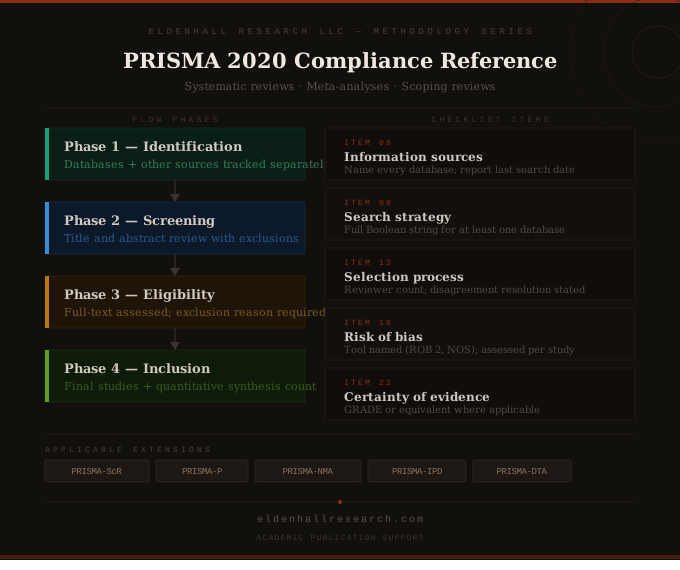
Systematic reviews earn their authority through transparency. This guide breaks down the PRISMA 2020 checklist, the four flow diagram phases, the five most-failed items, and which extension applies to your study design.
Eldenhall Research LLC | Research Methodology Series
Systematic reviews and meta-analyses occupy a privileged position in the evidence hierarchy. They synthesise large bodies of research, inform clinical guidelines, shape policy, and establish what a field considers settled knowledge. That privilege comes with a responsibility: transparency. PRISMA exists to enforce it.
What PRISMA Actually Is PRISMA — Preferred Reporting Items for Systematic Reviews and Meta-Analyses — is a reporting guideline, not a methodology. This distinction matters more than most researchers acknowledge. PRISMA does not tell you how to conduct a systematic review. It tells you what to report so that a reader can evaluate how you conducted it. The current standard is PRISMA 2020, which replaced the original 2009 version and introduced substantive changes to the checklist, the flow diagram, and the underlying rationale. It comprises a 27-item checklist covering title, abstract, introduction, methods, results, discussion, and other information — and a four-phase flow diagram tracking the movement of records from identification through screening to final inclusion. If you are currently submitting a systematic review to any indexed journal and citing the 2009 version, reviewers will flag it. The 2020 update is not optional.
The Four Phases of the PRISMA Flow Diagram The flow diagram is the most visible component of PRISMA compliance, and the most commonly misreported. The 2020 update restructured it to distinguish between database searches and other sources — a change many authors miss. Phase 1 — Identification. Records retrieved from databases are reported separately from records identified through other methods (citation searching, grey literature, hand-searching). Both streams feed into the diagram but are tracked independently. Report the number of duplicate records removed and the number of records excluded before screening. Phase 2 — Screening. Records are screened on title and abstract. The number excluded at this stage is reported. If automation tools were used for screening, that must be stated. Phase 3 — Eligibility. Full-text articles are assessed. Each exclusion must be accompanied by a reason. Vague categories such as "did not meet inclusion criteria" are insufficient — the specific criterion violated must be named. Phase 4 — Inclusion. The final number of studies included in the review and, separately, in any quantitative synthesis (meta-analysis), is reported. These are not always the same number, and conflating them is a common error.
The 27-Item Checklist: Where Authors Most Often Fall Short Full compliance requires attention to items that are frequently underdeveloped in submitted manuscripts. Item 8 — Information sources. Every database searched must be named and the date of the last search reported. "Several databases were searched" is not compliant. Scopus, Web of Science, PubMed, CINAHL, PsycINFO — each must be listed individually with the date range applied. Item 9 — Search strategy. At least one complete search string must be reproduced in full, including all Boolean operators, truncation symbols, and field codes. Most journals require this for at least the primary database. A summarised or paraphrased search string is not compliant. Item 13 — Selection process. The number of reviewers who independently screened records at each phase must be stated, along with how disagreements were resolved. Single-reviewer screening is a methodological limitation that must be explicitly acknowledged if used. Item 16 — Risk of bias. The tool used to assess study quality must be named — ROB 2, Newcastle-Ottawa Scale, CASP checklist, or equivalent — and the results reported for each included study, not just summarised in aggregate. Item 22 — Certainty of evidence. Where applicable, GRADE or equivalent certainty assessment should be reported. Many authors in non-clinical fields omit this entirely; whether it is required depends on journal scope, but its absence should be a deliberate choice, not an oversight.
PRISMA Extensions: Which One Applies to Your Study PRISMA 2020 addresses conventional systematic reviews. For specific designs, official extensions exist and carry equal weight with reviewers:
PRISMA-ScR — Scoping reviews PRISMA-P — Protocols (published before data extraction) PRISMA-NMA — Network meta-analyses PRISMA-IPD — Individual participant data reviews PRISMA-DTA — Diagnostic test accuracy reviews PRISMA-Harms — Adverse effects reporting PRISMA-CI — Complex interventions
Using the base PRISMA 2020 checklist when your study is a scoping review or NMA is non-compliant. The extension checklist replaces or supplements the base checklist — always verify which applies before submission.
What Non-Compliance Costs You The consequences of incomplete PRISMA reporting are concrete. Most Q1 and Q2 journals in medicine, public health, psychology, and education now require the PRISMA checklist to be submitted alongside the manuscript, with page numbers indicating where each item is addressed. A missing page number column is sufficient grounds for desk rejection at journals with strict editorial standards. Beyond desk rejection, non-compliance during peer review creates a specific kind of reviewer comment that is difficult to resolve at revision stage — particularly for the flow diagram and search strategy, which require either retroactive documentation or acknowledgment of a methodological limitation. Neither response strengthens a manuscript. The more serious long-term consequence is reproducibility. A systematic review that does not report its search strategy completely cannot be updated, verified, or challenged. In a field where systematic reviews inform practice and policy, that is not a minor omission.
A Practical Compliance Workflow Before submission, complete the following in sequence:
Download the PRISMA 2020 checklist from prisma-statement.org — use the official version, not a reproduced one. Complete the checklist with exact page numbers, not section names. Reviewers verify these. Regenerate the flow diagram using the 2020 template, ensuring the database and other-sources streams are separated. Confirm your search strings are reproduced in full — at minimum in a supplementary file if journal word limits prevent inclusion in the main text. Verify that your risk-of-bias tool is named and applied at the study level, not summarised across the sample. If your design qualifies for a PRISMA extension, attach the extension checklist as well.
Compliance is not bureaucracy. It is the mechanism by which a review earns the right to be believed. In a literature crowded with poorly reported syntheses, a fully compliant manuscript signals methodological seriousness to editors and reviewers before they read a single sentence of your findings.
Eldenhall Research LLC supports researchers with systematic review methodology, PRISMA documentation, and manuscript preparation for indexed journals. Visit eldenhallresearch.com to enquire.