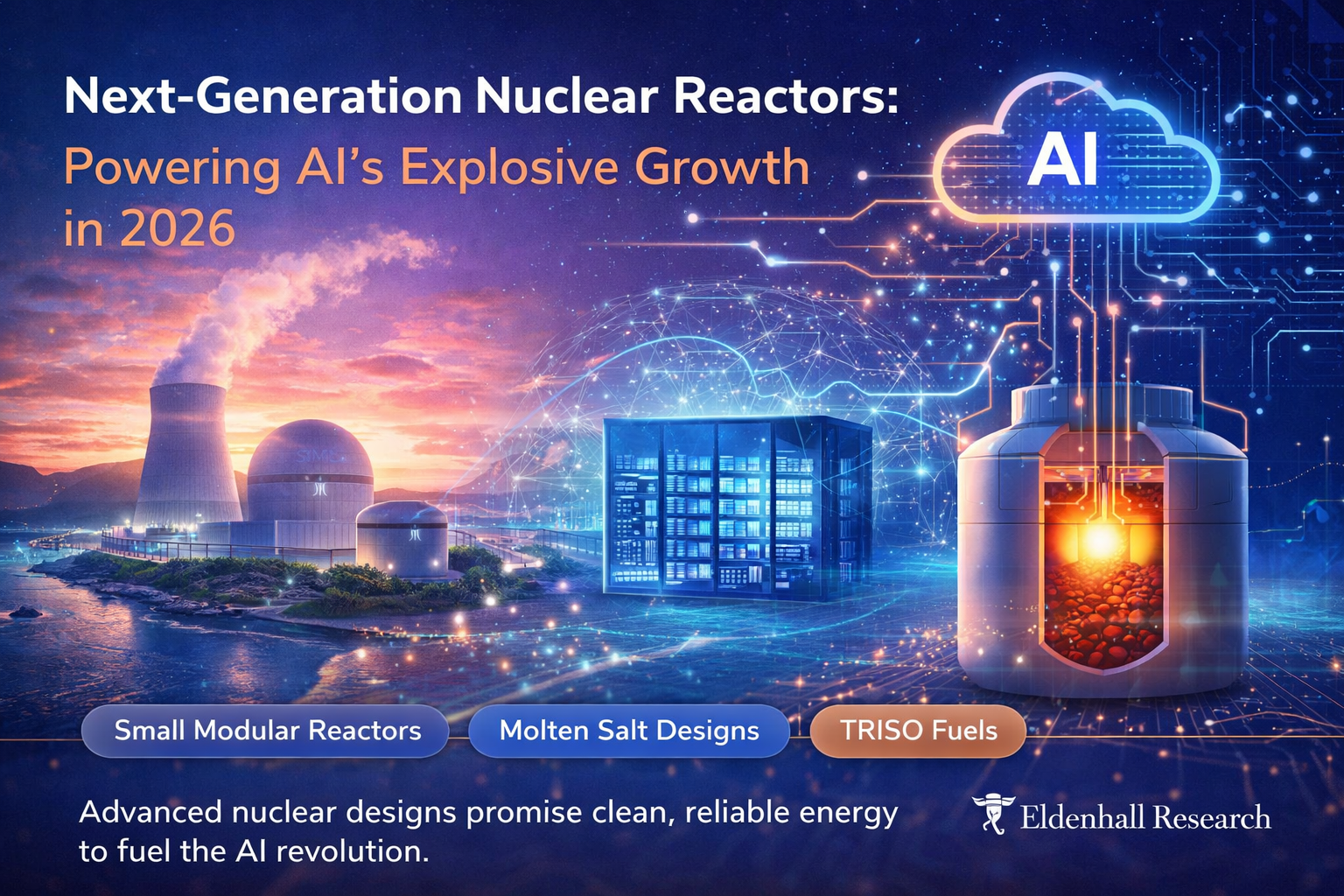
In this latest Eldenhall Research blog, we break down why advanced nuclear reactors have become one of the hottest topics in 2026. With AI data centers driving massive electricity demand, next-gen designs (SMRs, molten-salt reactors, TRISO fuels, and modular builds) offer the clean, always-on power needed to fuel the AI boom without compromising climate goals. We cover the current energy crunch, real 2026 milestones, practical innovations, industry impact, and honest challenges plus a forward-looking view on how this technology will accelerate AI progress for years to come. Perfect for researchers, tech leaders, and energy professionals who want a clear, no-hype update on the nuclear-AI revolution.
As AI models grow more sophisticated and data centers scale to hyperscale proportions, the world faces an unprecedented energy challenge. Clean, reliable, always-on power is no longer optional—it's the foundation for the next wave of innovation. In 2026, next-generation nuclear reactors are stepping into the spotlight as one of the most promising solutions.
At Eldenhall Research, we track emerging technologies that blend scientific breakthroughs with real-world impact. This isn't just another energy trend; it's a convergence of policy momentum, advanced materials science, and urgent demand from the AI sector. Here's a clear-eyed look at why these reactors represent a high-impact research frontier right now—and what it means for industries, governments, and the planet.
The AI Energy Crunch That's Reshaping Energy Policy
Hyperscale AI data centers are already consuming electricity at staggering rates. Projections show data-center power demand could double by 2030, largely driven by training and running massive models. Traditional renewables like solar and wind are vital but intermittent, while natural gas still carries emissions baggage.
Nuclear power, long a steady baseload source, is experiencing a renaissance precisely because of this crunch. In the United States, a 2024 law streamlined reactor licensing, and both recent administrations have supported financing and exports. Advanced technology demonstrations funded by the Department of Energy are nearing fruition. Globally, the story is similar: countries are accelerating deployment to meet net-zero goals while satisfying AI infrastructure needs.
The result? Nuclear is no longer viewed as yesterday's technology. It's the dispatchable, low-carbon backbone that AI demands in 2026 and beyond.
What Makes Next-Generation Reactors Different
Traditional large reactors take years to build and face high upfront costs. The new designs change the equation through three key innovations:
- **Compact, modular architectures**: Small modular reactors (SMRs) and micro-reactors can be factory-built, shipped, and assembled on-site in a fraction of the time.
- **Advanced fuels and cooling systems**: TRISO (tristructural isotropic) particle fuel offers exceptional safety and high-temperature performance. Molten-salt reactors use liquid fuel that drains passively in emergencies, dramatically reducing meltdown risks.
- **Alternative coolants and fuels**: Some designs run on recycled nuclear fuel or thorium, cutting waste and proliferation concerns.
These breakthroughs—highlighted in MIT Technology Review's 2026 list of Breakthrough Technologies—allow faster deployment, lower costs, and siting flexibility (even near data centers). Early commercial projects and demonstration plants are expected to reach key milestones throughout 2026, moving from planning to grid connection in record time.
Real-World Momentum and 2026 Milestones
Several developments signal 2026 as a pivotal year:
- U.S. projects leveraging the new licensing framework are advancing toward operational status.
- International exports and financing deals are accelerating, particularly in regions with growing AI infrastructure.
- Integration with renewables: Next-gen reactors pair naturally with solar and battery storage (including emerging sodium-ion alternatives) for hybrid clean-energy hubs.
Research teams worldwide are also pushing materials science frontiers—improving corrosion resistance, radiation-tolerant alloys, and digital twins for predictive maintenance.
Why This Matters for Research and Industry
For technology companies building AI infrastructure, next-generation nuclear offers a path to energy security without compromising sustainability targets. For utilities and governments, it means reliable decarbonization at scale. For the research community, it opens exciting interdisciplinary opportunities: nuclear physics meets AI-optimized control systems, advanced manufacturing, and even climate modeling.
Compact reactors co-located with data centers could slash transmission losses and accelerate AI deployment timelines. Early insights suggest the economic and environmental returns could be transformative.
Addressing the Challenges Head-On
No technology is without hurdles. Safety remains paramount, and public trust depends on transparent regulation and waste-management solutions. Proliferation risks and long-term disposal strategies require ongoing research and international cooperation. Cost overruns on legacy projects have made investors cautious, but the modular approach and standardized designs are mitigating these risks.
Responsible development—balancing speed with rigorous oversight—will determine how quickly these reactors deliver on their promise.
Looking Ahead: A Clean-Energy Multiplier for the AI Era
2026 won't mark the end of the nuclear revival; it will mark its acceleration. As the first wave of next-generation reactors comes online and proves their value, expect a virtuous cycle: cheaper clean power enables more ambitious AI models, which in turn drive further energy innovation.
The intersection of artificial intelligence and advanced nuclear technology isn't just trending—it's foundational to the next decade of progress.
Whether you're in tech infrastructure, energy policy, or R&D leadership, now is the time to engage with these developments. The reactors being refined today will power the breakthroughs of tomorrow.
What are your thoughts on nuclear's role in the AI future? We'd love to hear from fellow researchers and industry leaders—drop a comment or reach out to our team for a deeper dive into the data.
Eldenhall Research – Illuminating tomorrow's technologies, today.