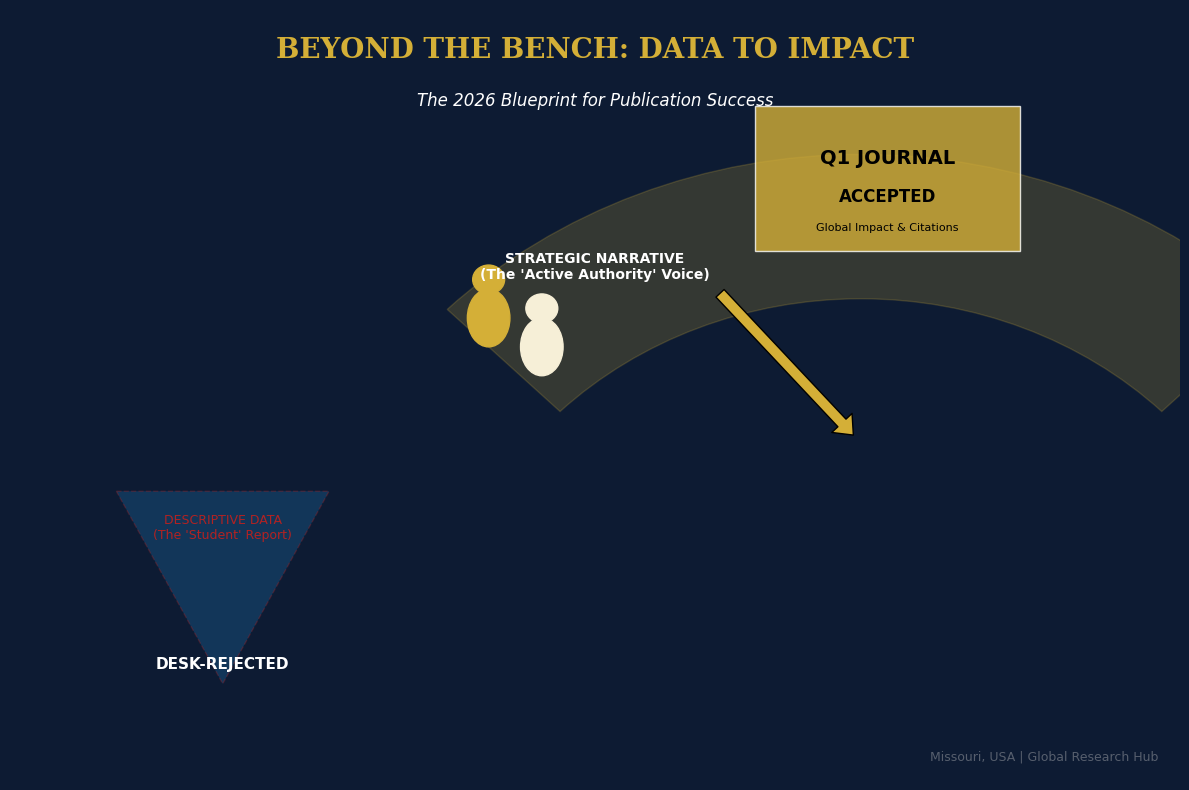
Referencing in modern research has evolved into a dynamic, blockchain-verified ecosystem where citations track real-time impact and the digital provenance of every idea.
In the current hyper-competitive era of 2026, the delta between a "Major Revision" and a "Desk-Reject" has narrowed to a razor's edge. After decades in the trenches of academic publishing, I’ve realized a hard truth: Excellent data does not guarantee a published paper. If you are a young researcher, you must shift your mindset. You are no longer a student reporting a lab experiment; you are a strategic communicator engineering a contribution to a global conversation. Here is the blueprint for navigating the 2026 publishing ecosystem.
1. The 5-Paper Rule of Journal Selection
The most common cause of rejection isn't poor science—it's Misalignment. Many researchers aim for high-impact factors without studying the "DNA" of the journal.
The Strategy: Before you write the first word, identify your top three target journals. Read five of their most recently published articles.
The Audit: Do they prefer theoretical depth or empirical breadth? Is their tone aggressive and provocative, or cautious and methodological? Journals don't just want "good" papers; they want papers that fit their specific "Intellectual Silhouette."
2. The "Three-Question" Introduction
Editors at elite Q1 journals often make a preliminary decision within the first 120 seconds. If your introduction doesn't establish Global Urgency immediately, you've already lost. Your first two pages must provide an airtight answer to:
What is the status quo? (The established landscape)
Where is the friction? (The specific, unsolved problem)
How does this paper resolve it? (The explicit contribution) If these three pillars aren't visible by page three, your manuscript is a report, not a research article.
3. The Methodology: Clarity Over Complexity
Young researchers often try to impress reviewers with unnecessary complexity. In reality, reviewers are looking for Vulnerability. They want to see a methodology so transparent that it could be replicated by a rival lab. A simple, perfectly executed study will beat a complex, "black-box" study every time. Clarity is the ultimate sign of professional maturity.
4. Navigating the Psychology of Peer Review
A "Revise and Resubmit" is not a critique; it is a Roadmap. One of the greatest mistakes a young researcher can make is becoming defensive.
Modern Best Practice: View the reviewer as a collaborator who is helping you "stress-test" your work for the global stage. Respond to every comment—no matter how minor—with professional gratitude and surgical precision. This signals to the editor that you are a "Safe Bet" for their journal’s reputation.
5. Formatting as a Proxy for Rigor
To an editor, sloppy formatting is a red flag for sloppy data. If an author cannot follow the "Instructions to Authors," how can the editor trust they followed rigorous ethical or statistical protocols? In 2026, automated formatting checks are the first gatekeepers. Don't let a font size or a citation style be the reason your breakthrough is silenced.
The 2026 Success Pillar: Persistent Evolution
Publication is not a trophy for intelligence; it is a reward for Resilience. Experienced researchers treat a rejection as a data point. They refine the narrative, tighten the methodology, and pivot to the next target. Success in publishing comes from understanding that the "Why" and the "How" are often more influential than the "What."